Showing posts with label Interviews. Show all posts
Showing posts with label Interviews. Show all posts
Thursday, 23 January 2014
Knit One Film One.
My documentary is finished! After reflecting on my documentary experience (in my next post), here is a link to "Knit One Film One". Enjoy!

Wednesday, 22 January 2014
The Editing Process.
The editing process of film making is possibly my favourite part of creating a film. I usually edit on my own, so I can sit for hours and finely tune everything as best I can and it doesn't feel like work. I worked for a number of days on my edit, before Christmas and after Christmas, and I'm very pleased with how it turned out.
After everything had been shot, I was a lot more happier to edit because I already felt like I was closer to finishing it even though I had just started. I encountered a small number of basic problems while editing but I feel like I handled them well with my best efforts.

Colour Correction:
This was only due to either not the right white balance being set or the fact that the lights I used where normal household lights and most lights like this, do have a yellow tint to them. After spending at least two or three days on colour correction, I did what I could but there is only really so much you can do before you start going into over exposure or making it too dark. Despite this, I don't think it takes away from the documentary, which I'm very happy about.
More Footage:
Part of me doesn't want to have to say that I wanted more footage because I already spent hours deliberating what shots to use, and this wasn't because of a lack of footage by any means. The shots I took after I interviewed my Mum; I got a few shots of her knitting and if I could do it differently, I probably would have got my camera out only for a minute or so every time she was knitting something different and created a short montage piece of the various things she was knitting. I just think it would have added slightly more depth to the piece.
My Mum's interview.
Over the Christmas period I conducted the interview with my Mum. She brought a lot to the interview with funny stories, childhood memories and being quite comfortable in front of the camera, despite being very nervous beforehand.

Once I had asked her all her interview questions, I got a number of close ups of her knitting and with her tea. The tea element was important to me because tea often relates to being sociable and this is what her knitting group is about, as well as knitting of course.


I was pleasantly surprised how easy it was to interview my Mum. Some would say I have an advantage interviewing someone I know so well, but I was still nervous at the prospect. The only thing I would have changed about this is I would have worked more on sorting out the lighting problems. Everything looked fine on the camera at the time but as I put it on the big Mac screen, it turned out that it was quite yellow. With this happening, I spent a good majority of my editing time trying to colour correct the interview. In the end, there is only so much you can do unfortunately but I don't think it ended up being too bad or at least I don't think it would be too overly obvious to anyone who wasn't a film student.
Once I had asked her all her interview questions, I got a number of close ups of her knitting and with her tea. The tea element was important to me because tea often relates to being sociable and this is what her knitting group is about, as well as knitting of course.
Thursday, 12 December 2013
"Stories We Tell"
In last Thursday's class, we watched another documentary. This documentary was by Sarah Polley, a Canadian actress and director; having starred in "Dawn of the Dead" and "Mr. Nobody" as well as also directing "Away from Her". This documentary was very eye opening, especially when it came to interview techniques because it was unlike any documentary I had seen before. I recently spoke about "The Conversation with Amanda De Cadanet" and not only about the topics she discusses but how she interviews. A link to that post can be found here (x).


"Stories We Tell" is about Sarah Polley's family, mainly concentrating on their mother and father's relationship. My favourite piece of information that I found out about this documentary is that Sarah doesn't call her interviewees, interviewees; she calls them "storytellers" and in all honesty, I had never thought about this until now, and it's absolutely true. If something happened and you ask five people what happened; you're more than likely going to get a alternative version of the situation, you will never get the one hundred percent truth to what happened because it always have a little differently depending on each person. So the same can be said for any type of family situations, including the ones Sarah's family talk about in the film. The same names are mentioned and certain situations are talked about but with a slight variation.
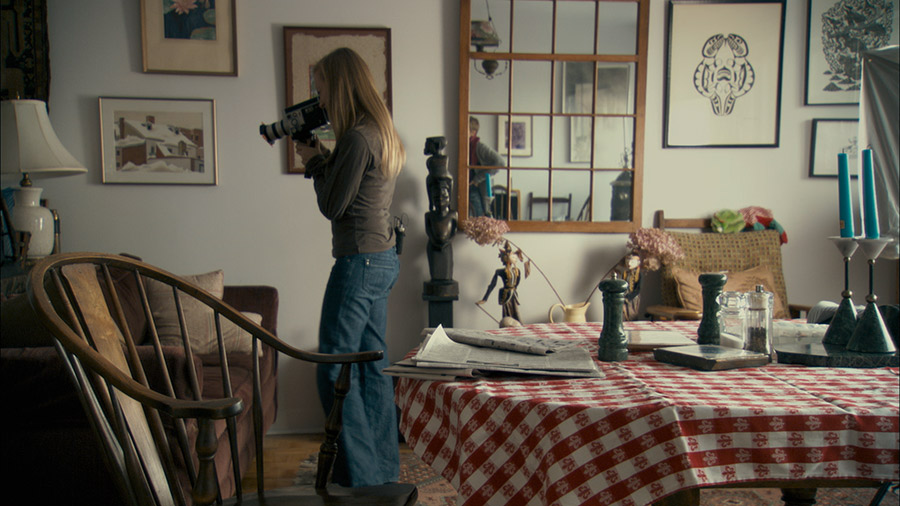
(A shot taken from the set of Sarah setting up for her interviews with her family)
As I mentioned earlier in the post, I was blown away by her interview techniques especially. The beginning of the film shows Sarah setting up her interviews, and this shows how nervous her family members are. Normally in anything, be it documentary or television show, we never normally see the beginning before the beginning of the interview. Sarah sits behind the camera and you can hear her ask the questions in the film, but most interview tend to take out their questions and have the questions be told in such a way that it is asked through the videos and photographs on screen. Although this use of question asking is quite visual, it's always refreshing to hear the question from the director or interviewer themselves. What I found extraordinary, was when her family sat down, Sarah asked them to essentially tell their full life story and they were surprised that they would have to tell the entire story, but they didn't seem to know this before the interview.
We see boom mics, the setting up of the camera, the storytellers are sitting down and everything they said from the moment they sit down, is all recorded. As well as the interviews, some of the home footage shots are actually dramatized and grains are added to give the impression that these shots are old footage. An example of this is shown below, and it is very well done, because until I researched this film further, I didn't pick up on the dramatization at all. The footage of Michael (Sarah's non-biological father) being told that he isn't her biological father, you can tell that it has been dramatized, but the older looking footage is harder to recognize.
(One of the dramatized shots made to look like home footage)
I was also fascinated by some of the interview environments and the shots used throughout the film. With the interviews, the home environment was used for the majority of them along with shots of her father recording their story in the recording studio, as Sarah sits on the other side of the booth listening in and adjusting his levels. The recording that her father does is used throughout the film to put over footage or photographs, when the interviews with her family aren't being shown.
Looking at "The Conversation"
After thinking over the options I could explore having one less knitting group to film, I came to the decision to add interviews into my documentary. We had briefly considered this but it was one of our Plan B options for the time being. (Lesson? Always plan for a Plan B, C, and even D). One of the interviews I wanted to conduct was with my Mum. She doesn't like being on camera too much but she said she didn't mind doing it for this production.
Over the past week I have been looking at different techniques of interviews, and as well as the research we done in our research module, I looked at "The Conversation with Amanda De Cadanet" and "Stories We Tell". I have already spoken about "Stories We Tell" in a separate post, which will be linked here (x).
"The Conversation with Amanda De Cadanet" explores women's lives with everything from sex and love, to self acceptance and being your own motivation. Amanda's interview techniques is very unlike any other interviewer I have ever watched; the interview is always very relaxed and they will often be in very relaxed clothing.

Over the past week I have been looking at different techniques of interviews, and as well as the research we done in our research module, I looked at "The Conversation with Amanda De Cadanet" and "Stories We Tell". I have already spoken about "Stories We Tell" in a separate post, which will be linked here (x).
"The Conversation with Amanda De Cadanet" explores women's lives with everything from sex and love, to self acceptance and being your own motivation. Amanda's interview techniques is very unlike any other interviewer I have ever watched; the interview is always very relaxed and they will often be in very relaxed clothing.
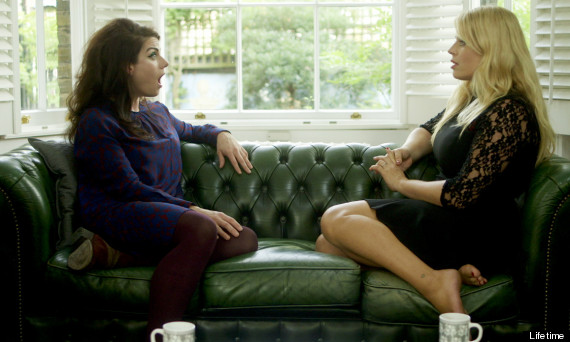
(Caitlin Moran and Amanda De Cadanet on "The Conversation")
In this interview, the interviewer Amanda is clearly in front of the camera along with her guest Caitlin Moran. They're both dressed very casually, with Amanda in a black lacy dress but making it not as formal by having no shoes or socks on. The interviewee, Caitlin, is also going for something very similar with dark coloured leggings, a country style boot and a long blue t-shirt style dress. Many of the shots are very intimate, with two of the shots being mid shots of the woman along with the two shot of them sitting together (which you can see above). Choosing to use these shots show that the woman are close and not afraid to talk about anything.
The interview topics are always something you think about afterwards. Unfortunately because of the way society still looks at women, if men were to watch they may not feel the same way a woman would. They talk about a wide range of topics including: self-reflection, love and divorce, changing the world one woman at a time, parenting, wellness and sexuality, to name a few. In my interview with my Mum, we won't be exploring those topics but I wanted to talk about Amanda's interview techniques because she makes her guests feel so comfortable and that's something that every interviewer strives for, but may not necessarily get, depending on their own interview style.
If you haven't seen "The Conversation", I've added a YouTube video of one of the shorter versions of the show that have been taken from the longer episodes and split up for YouTube. In this interview, Amanda De Cadanet talks to Zoe Saldana about not being defined by anything, how she actually likes her mistakes because she learns from them every time and growing up with that close bond with her two sisters.
The interview topics are always something you think about afterwards. Unfortunately because of the way society still looks at women, if men were to watch they may not feel the same way a woman would. They talk about a wide range of topics including: self-reflection, love and divorce, changing the world one woman at a time, parenting, wellness and sexuality, to name a few. In my interview with my Mum, we won't be exploring those topics but I wanted to talk about Amanda's interview techniques because she makes her guests feel so comfortable and that's something that every interviewer strives for, but may not necessarily get, depending on their own interview style.
If you haven't seen "The Conversation", I've added a YouTube video of one of the shorter versions of the show that have been taken from the longer episodes and split up for YouTube. In this interview, Amanda De Cadanet talks to Zoe Saldana about not being defined by anything, how she actually likes her mistakes because she learns from them every time and growing up with that close bond with her two sisters.
This isn't a documentary, it is a "totally different interview series" but I feel like these techniques can be used all over various mediums from actual interviews to comparing them to other documentaries.
Subscribe to:
Posts (Atom)